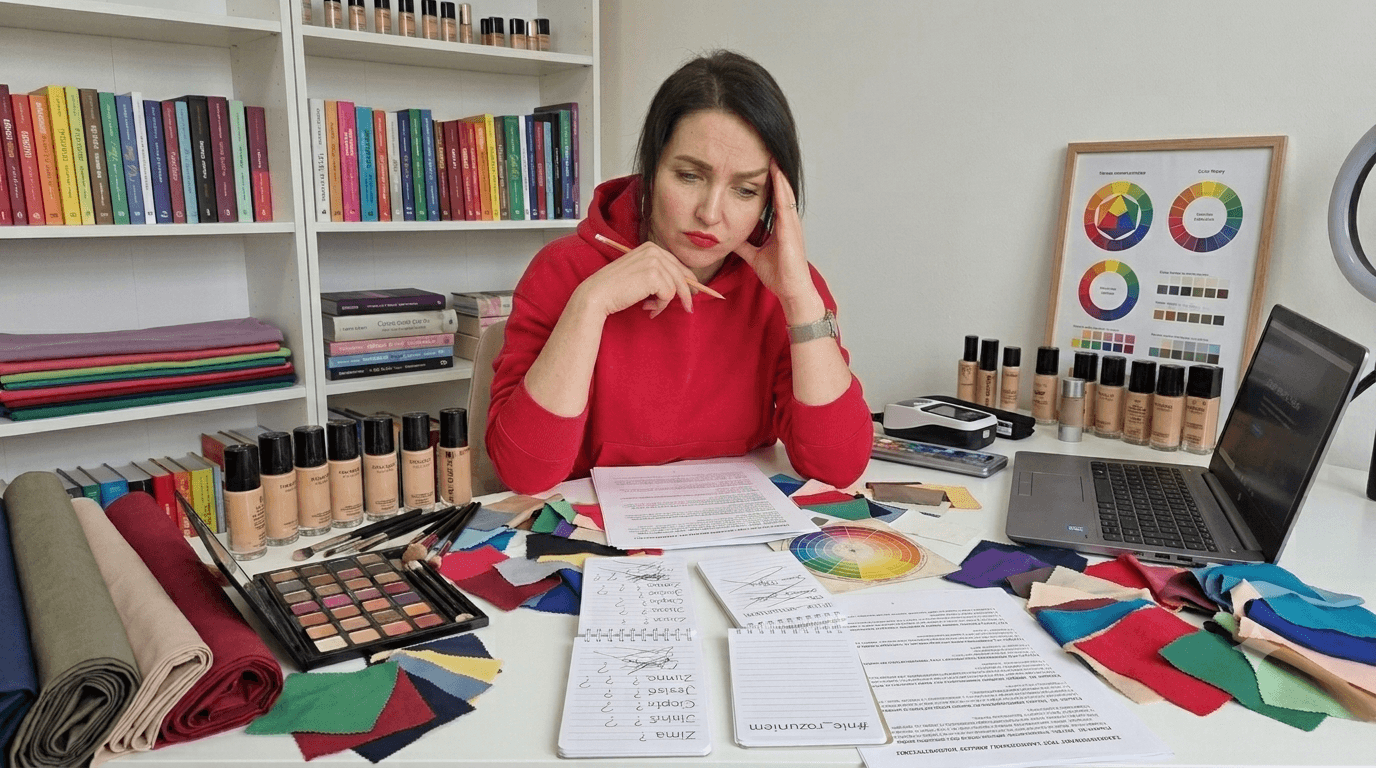
You can certainly notice that some colours make your face look better than others. It is much harder, however, to reliably determine your colour season based on those observations alone.
There are dozens of online tests that promise a quick answer to the question: “What is my colour season?” All you have to do is identify your eye, hair and skin colour, check the colour of your veins, or hold gold and silver jewellery next to your face.
The problem is that colour analysis is not about ticking off a few boxes based on your appearance.
When doing a colour test on your own, it is easy to assess several things at once: whether you like a particular colour, whether it suits your style, hair or eyes, or whether you are simply used to seeing yourself in those colours.
Colour analysis focuses on something else.
The question is not: “Do I like this colour?” It is: “What does this colour do to my face?”
And this is where determining your colour season on your own becomes much more difficult.
1. You may be judging the colour rather than your face's reaction to it
Imagine standing in front of a mirror wearing a navy top and thinking: “I look great in this.”
But why?
Perhaps you like navy. Maybe you associate it with elegance. Maybe you feel good in this style or simply wear this colour often.
None of those answers is wrong. But they do not answer the question of how navy affects your face.
During a colour analysis, we observe, among other things, whether a colour makes the face appear more rested and harmonious, or whether it brings out shadows, redness or unevenness.
It is a subtle difference, which is exactly why doing a colour season test on your own can be difficult.
You may genuinely love a particular colour while it is not necessarily one of the colours that works best with your natural colouring.
2. It is easy to confuse temperature with other colour properties
Many people start by asking: “Am I warm or cool?”
But colour has more than one characteristic.
A colour can be lighter or darker, more intense or muted, warmer or cooler.
If the two colours you are comparing differ in several properties at once, it becomes difficult to identify what is actually responsible for the effect.
You might think: “This warm colour doesn't suit me.”
But temperature may not be the problem at all. Perhaps the colour is simply too dark, too intense, or creates too much contrast next to your face.
That is why a simple “warm versus cool” test is not enough to reliably determine your colour season.
3. Lighting can change the result of a colour test
It may seem simple enough: stand in front of a mirror and hold a few colours next to your face.
But the result of a colour analysis you do on your own can be affected by:
- natural or artificial light,
- the time of day,
- the temperature of the lighting,
- the colour of the walls and surroundings,
- reflected light from nearby surfaces.
If you test colours in the evening under a warm light bulb, you may see them very differently than you would in neutral daylight.
A camera also processes an image and can change the way we see the colours of skin and clothing.
That is why the result of a single at-home test is not necessarily something you should use as the basis for your entire wardrobe.
4. Photos and AI apps can be wrong too
More and more apps and AI tools promise to determine your colour season from a photograph.
They can be an interesting starting point, but it is worth remembering that the app is analysing an image that has already been processed by a camera.
Its appearance can be affected by:
- white balance,
- exposure,
- automatic image processing,
- filters,
- camera quality,
- makeup,
- dyed hair.
So if one app tells you that you are a Winter, another says Summer, and a third identifies you as an Autumn, it does not necessarily mean that your colouring is “impossible to determine”.
It may simply reflect the limitations of a method based on a single photograph.
So, can you determine your colour season from a photo? A photograph can help you notice certain features, but it does not offer the same possibilities as directly comparing colours next to your face.
5. One colour that looks good on you does not determine your entire colour season
You may look fantastic in a particular shade of green.
But that alone is not enough to determine your colour season.
Determining your colour season based on a single colour is like judging an entire book by one sentence.
One colour can be an important clue, but it does not answer the question of which colour properties create the greatest harmony with your natural colouring.
That is why popular online rules such as: “If this colour looks good on you, you must be...” should be treated with caution.
Some colour analysis systems describe colour seasons using Spring, Summer, Autumn and Winter. More detailed systems also take characteristics such as temperature, lightness and intensity into account.
That does not mean, however, that you can simply match a few features of your appearance to a description you found online.
6. Eye colour, vein colour, or choosing gold over silver do not give you the full answer
These are some of the most popular methods for determining your colour season at home.
A quiz may ask about your eye and hair colour. Someone else may tell you to check the colour of your veins. Another test may suggest holding gold and silver next to your face.
These tests can be interesting. They may even provide some clues.
But they are not the same as observing how your face reacts to colour.
Two people with the same eye colour can react very differently to the same colours. Likewise, simply deciding that “gold looks better than silver” does not tell you which colours and colour properties will work best with your overall natural colouring.
Does vein colour determine your colour season?
A popular test suggests that greenish veins indicate a warm colour season, while blue or purple veins indicate a cool one.
It is better to treat this method as a curiosity rather than as a basis for determining your entire colour season.
Personally, the veins on my left hand look purple, while the ones on my right hand look green. Strange, I know, but this one example alone makes me question the whole theory.
The same applies to the gold-versus-silver test. It can be an interesting comparison, but one observation cannot tell you which colour palette works best with your face.
7. You may be used to colours that do not show your face at its best
This is one of the most interesting reasons why doing a colour analysis on your own can be difficult.
If you have worn mostly black, intense colours, or a very specific palette for years, seeing yourself in those colours becomes familiar.
It becomes your visual norm.
When you eventually try a colour that harmonises better with your natural colouring, your first reaction may be: “I look different.”
And it is very easy to confuse: “I look different” with “I look worse.” I hope that, as you're reading this, those two sentences sound as similar in your head as they do in mine.
The same can apply to makeup, dyed hair or a signature personal style.
That is why colour analysis is not only about what we see, but also about being able to recognise changes that we are not yet used to seeing.
How can you determine your colour season?
If you want to determine your colour season on your own, treat online tests as a starting point rather than a final answer.
Instead of focusing only on your eye, hair or vein colour, pay attention primarily to how your face reacts to different colours.
It is also important to compare colours under similar conditions. If you test one colour next to a window and another under artificial lighting, it is difficult to compare the results reliably.
And above all: do not try to force yourself into one colour season based on a description you found online.
If you want to know your colour season, you do not have to guess
Experimenting with colours on your own can be a great starting point. You can discover new shades, notice differences you had not seen before, and develop a better understanding of your appearance.
But if you want a specific answer based on observing how your face reacts to colour, rather than on a quiz, vein colour or a single photograph, a professional colour analysis is worth considering.
During a colour analysis at Quest Style with Aleksandra Stróżniak, we look at which colour properties work best with your natural colouring and how to translate the result into everyday choices.
This means you no longer have to wonder whether an online test got it right.
You also do not have to keep buying clothes that are supposedly “right for your season” without understanding why a particular colour should suit you.
Instead of guessing, you can see how your face reacts to colour and understand what actually creates harmony.
Book a colour analysis at Quest Style with Aleksandra Stróżniak and stop choosing colours through trial and error.
← Back to blog